Previous parts:
On September 1, 2013, the Brazilian television news program Fantástico broadcast a report revealing the NSA had been conducting surveillance on the presidents of Brazil and Mexico. Based on documents provided by Glenn Greenwald, the segment on the Globo network detailed how the agency had systematically intercepted the personal communications of Brazilian President Dilma Rousseff and her Mexican counterpart, Enrique Peña Nieto.
The documents highlighted the depth of the operation. One slide showed the NSA reading Enrique Peña Nieto's emails a month before his election, accessing sensitive communications, while others revealed the use of a tool called DNI Presenter to track President Rousseff's communication patterns, mapping who her aides spoke with and how they interacted. This data collection was reportedly achieved through an undefined partnership between U.S. and Brazilian telecommunication companies, giving the agency a direct line into the nations' highest offices.
One day later, Globo published the NSA slides featured in the Fantástico broadcast.
This post is not a comprehensive analysis of the slides. For a detailed breakdown, we recommend reading Electrospaces' analysis.
Piecing together new information
The broadcast included several b-roll style cutaway shots, filming the NSA slides on a monitor at extremely close range. Independently, many of these shots reveal little of significance, but when pieced together, they expose information that was redacted from the officially published slides.
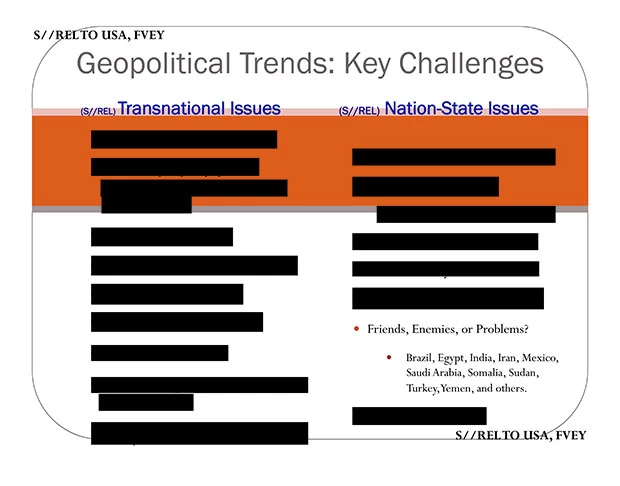
Here is one of the published slides - heavily redacted. We see that only two bullet points are visible, the rest are redacted.
The following close-up shots of the same slide were shown at various points throughout the broadcast.
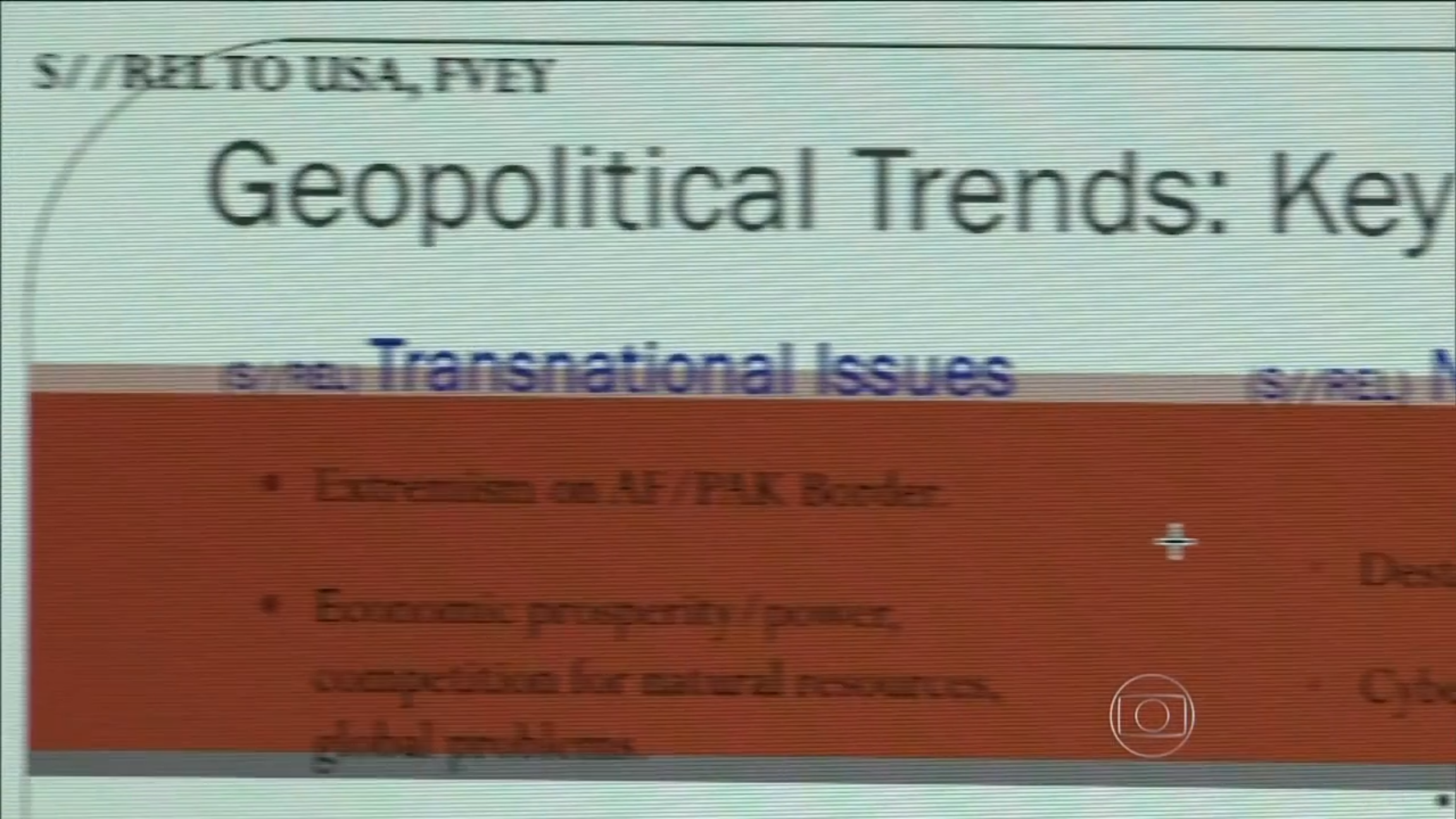
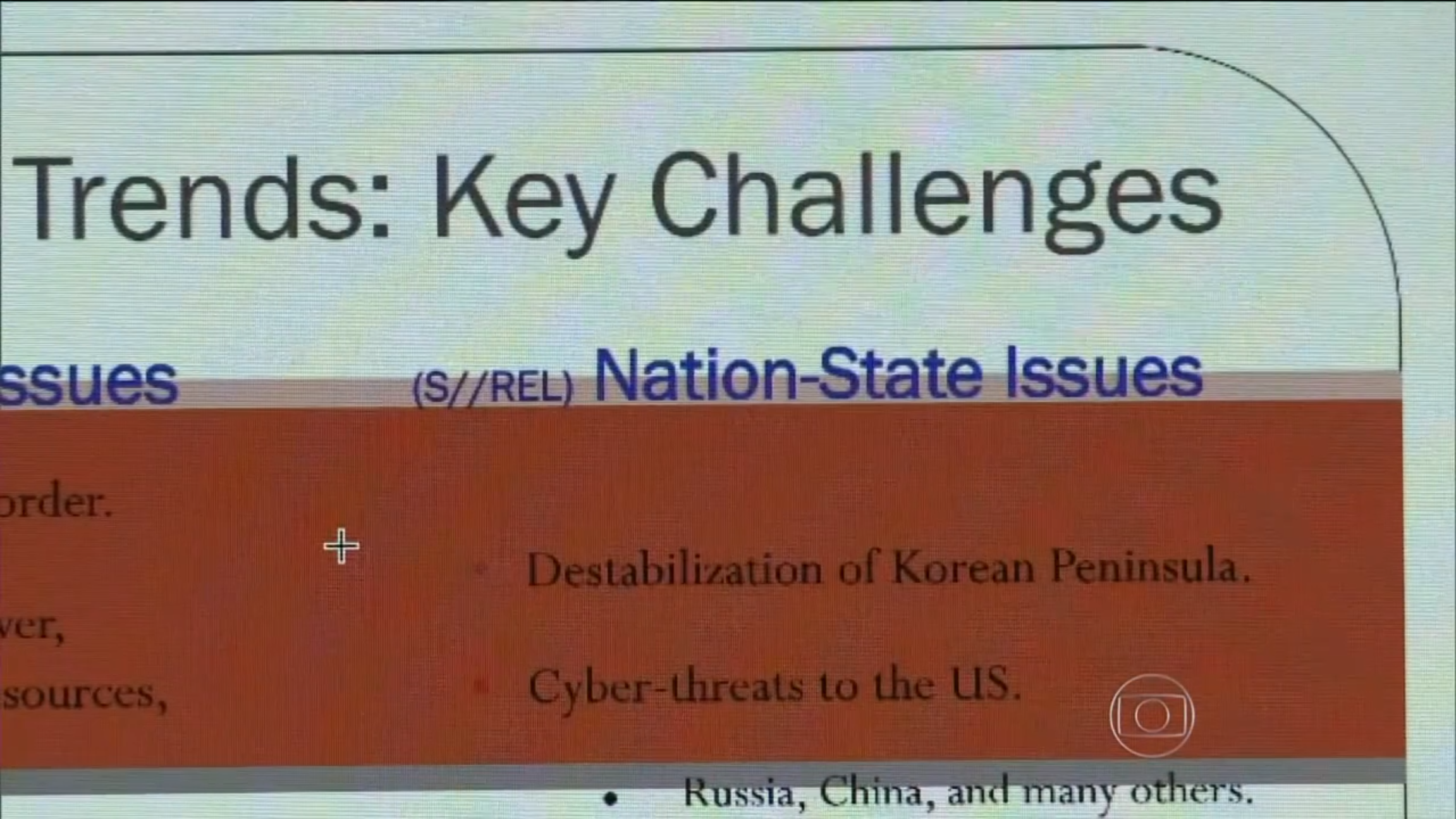
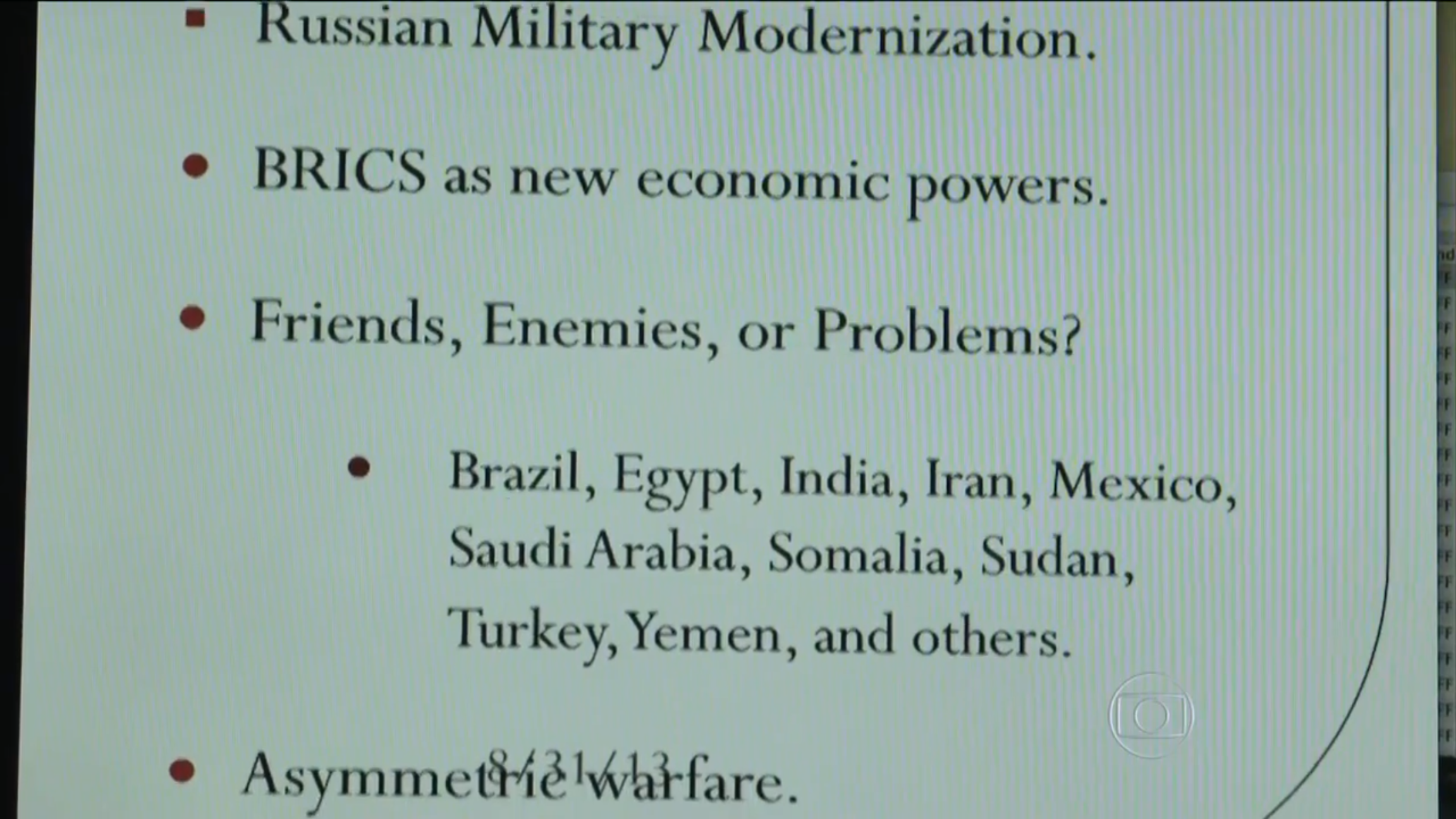
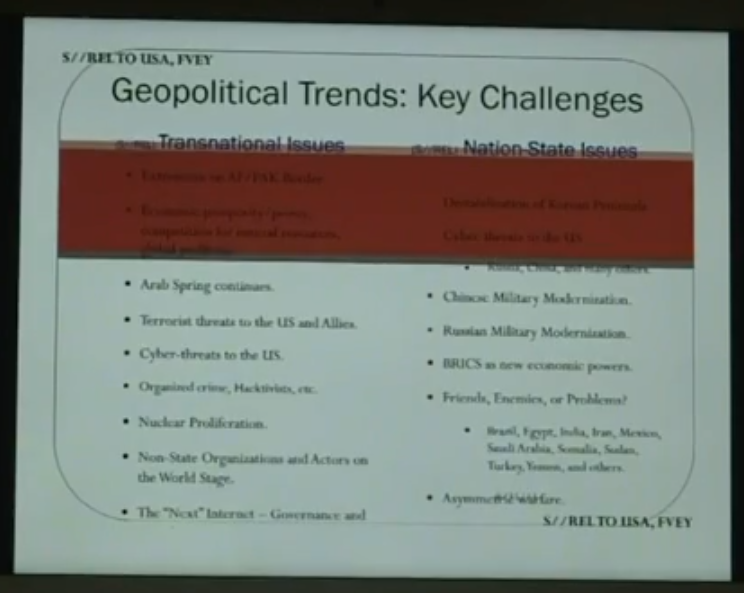
From these, we can piece together the entire slide:
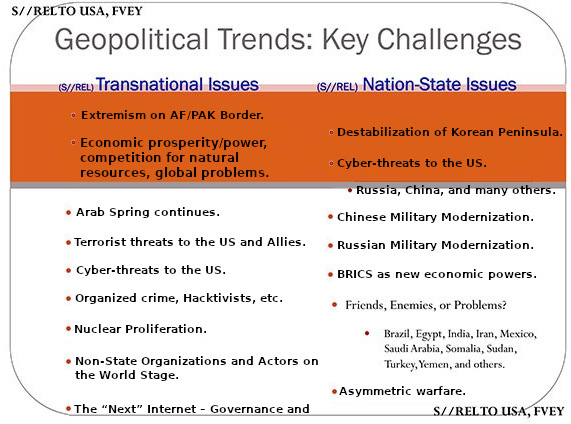
Geopolitical Trends: Key Challenges

(S//REL) Transnational Issues
* Extremism on AF/PAK Border.
* Economic prosperity/power, competition for natural resources, global problems.
* Arab Spring continues.
* Terrorist threats to the US and Allies.
* Cyber-threats to the US.
* Organized crime, Hacktivists, etc.
* Nuclear Proliferation.
* Non-State Organizations and Actors on the World Stage.
* The “Next” Internet – Governance and

(S//REL) Nation-State Issues
* Destabilization of Korean Peninsula.
* Cyber-threats to the US.
    * Russia, China, and many others.
* Chinese Military Modernization.
* Russian Military Modernization.
* BRICS as new economic powers.
* Friends, Enemies, or Problems?
    * Brazil, Egypt, India, Iran, Mexico, Saudi Arabia, Somalia, Sudan, Turkey, Yemen, and others.
* Asymmetric warfare.
Few interesting points from this slide:
-
Hacktivists are explicitly mentioned alongside major national security threats like nuclear proliferation and terrorism. This likely reflects the concerns over organizations like Anonymous and WikiLeaks.
-
The mention of BRICS is noteworthy. To date, this and only one other known published Snowden document explicitly mention the economic bloc.
-
The final bullet under "Transnational Issues" is cut off, reading "The “Next” Internet – Governance and". The context suggests this refers to the challenges posed by the evolving internet, like social media, cloud computing, and mobile platforms, and the geopolitical struggle over who governs these new centers of power.
-
The decision to redact this slide is questionable and reflects a common pattern in the published Snowden documents: redacting information that does not meet a high threshold for secrecy. The bar for redacting information in public interest disclosures should be exceptionally high, not applied to general (geo)political observations like these.
Excerpt vs. full document
Another key item shown in full during the Fantástico broadcast was a 2009 letter from Assistant Secretary of State Thomas Shannon to NSA Director Keith Alexander. While an excerpt of this letter was shown in Glenn Greenwald's book No Place to Hide, the full version provides crucial context that deepens its significance.
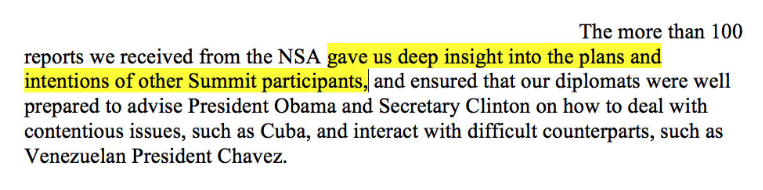
Excerpt in No Place to Hide (page 90):
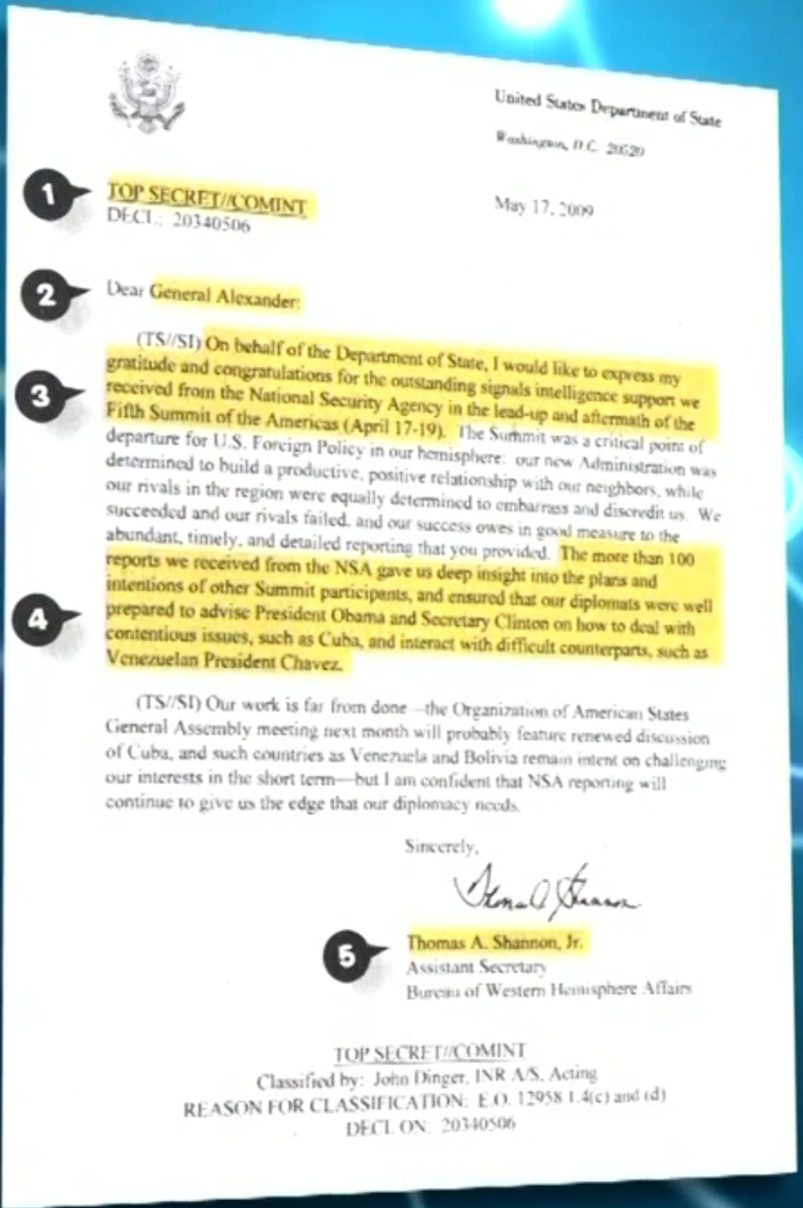
Full document, totally unredacted:
United States Department of State
Washington D.C.

TOP SECRET//COMINT
DECL: 20340506

May 17, 2009

Dear General Alexander:

(TS//SI) On behalf of the Department of State, I would like to express my
gratitude and congratulations for the outstanding signals intelligence support we
received from the National Security Agency in the lead-up and aftermath of the
Fifth Summit of the Americas (April 17-19). The Summit was a critical point of
departure for U.S. Foreign Policy in our hemisphere: our new Administration was
determined to build a productive, positive relationship with our neighbors, while
our rivals in the region were equally determined to embarrass and discredit us. We
succeeded and our rivals failed, and our success owes in good measure to the
abundant, timely, and detailed reporting that you provided. The more than 100
reports we received from the NSA gave us deep insight into the plans and
intentions of other Summit participants, and ensured that our diplomats were well
prepared to advise President Obama and Secretary Clinton on how to deal with
contentious issues, such as Cuba, and interact with difficult counterparts, such as
Venezuelan President Chavez.

(TS//SI) Our work is far from done–the Organization of American States
General Assembly meeting next month will probably feature renewed discussion
of Cuba, and such countries as Venezuela and Bolivia remain intent on challenging
our interests in the short term–but I am confident that NSA reporting will
continue to give us the edge that our diplomacy needs.

Sincerely,
Thomas A. Shannon, Jr.
Assistant Secretary
Bureau of Western Hemisphere Affairs

TOP SECRET//COMINT
Classified by: John Dinger, INR A/S, Acting
REASON FOR CLASSIFICATION: E.O. 12958 1.4(c) and (d)
DECL ON: 20340506
Greenwald's book used a key paragraph from the letter to provide a smoking gun for diplomatic and economic espionage. It proved, in the State Department's own words, that NSA surveillance gave the U.S. "deep insight into the plans and intentions of other Summit participants" and provided "negotiating advantages" over them. This revelation was powerful, confirming that the NSA's capabilities were being used to give American diplomats an unfair edge in economic talks.
However, the full document, as broadcast by Fantástico, reveals that the story is much bigger than just gaining a temporary advantage at a single summit. The omitted details paint a picture of a broader, ongoing, and more adversarial strategy.
While the excerpt in Greenwald's book sounds clinical, the full letter is far more aggressive in tone. Shannon writes that America's rivals "were equally determined to embarass and discredit us," and proudly states, "We succeeded and our rivals failed." This reframes the summit from a diplomatic meeting into a zero-sum conflict, where espionage was a weapon to defeat rivals, not just to understand counterparts.
The most significant omission is the second paragraph. It reveals this was not a one-off operation. Shannon writes, "Our work is far from done," and confirms that the State Department is counting on the NSA for future events, specifically the upcoming "Organization of American States General Assembly meeting." He explicitly names Venezuela and Bolivia as ongoing challenges, demonstrating a sustained surveillance strategy against regional neighbors.
The letter's conclusion shifts the goal from gaining a temporary "advantage" to maintaining a permanent "edge." An advantage can be specific to one negotiation. An "edge" is a continuous state of superiority. This reveals the true strategic aim: to use surveillance to ensure the United States permanently maintains an information imbalance in all its diplomatic affairs.
To our knowledge, the complete letter has never been published in print or online by any outlet, nor has it been analyzed in detail, especially within English-language media or research. Its only known public appearance was in the fleeting frames of the Fantástico broadcast. Significant information detailing the strategic mindset behind diplomatic espionage has remained almost entirely overlooked.